
Are Colorado Arrest Records Public?
Usually, some part of an adult arrest record is open in Colorado. State law treats an arrest as an official action. Official-action records are open for inspection at reasonable times. Other statutes, court rules, and orders can still limit access. Open details may include the person's identity, the agency, the date and place, the charge, and later case events. That does not oblige every sheriff to run a live statewide search, post a photo, or add each new booking at once.
Access also depends on the custodian. A booking entry may sit on a county roster. A photo may live in a separate jail or police record system. Court filings and outcomes belong to the court. Someone released from jail may drop off a current-custody list even though the arrest record stays at the agency. So a missing web result proves nothing. It does not show that no arrest occurred.
Note: A current-custody list and a past arrest record answer different questions. The same name can appear on both.
Colorado Arrest Record Access Laws
Two statutes set the framework. The Colorado Criminal Justice Records Act, or CCJRA, governs records kept by criminal justice agencies. The Colorado Open Records Act, or CORA, reaches public records more broadly. The Attorney General's CORA and CCJRA overview explains the split. The official Colorado Revised Statutes, Title 24 holds the current code.
Section 24-72-302 defines key terms. These include arrest and criminal records information, basic identification information, official action, and criminal justice agency. Section 24-72-303 opens official-action records to inspection at reasonable times. Section 24-72-304 covers other records, including photos and recordings. Release there rests with the custodian's discretion. Section 24-72-305 permits withholding when another law, court rule, or order bars access. It also allows withholding on a permitted public-interest ground. Section 24-72-306 allows reasonable actual-cost fees for search, retrieval, and redaction.
One term needs care. "Basic identification information" includes a photograph. Yet nothing requires a sheriff to post it online. The custodian is the official who holds and answers for a record. A court disposition is the court's final action in a case. The Judicial Branch docket search handles court-case lookup.
| Rule | What it means for a request |
|---|---|
| Official action | Arrest and case-event information is generally open, subject to law. |
| Other records | Many files and images are released at the custodian’s discretion. |
| Withholding | Law, court rules, orders, or public interest may limit access. |
| Copy costs | Search, retrieval, redaction, and nonstandard copies may cost more. |
A good request names the person, an approximate arrest date, the agency, and the record sought. Add a booking or case number if known. Ask for the arrest record, photo, and disposition as separate items. If the wrong office receives it, the CCJRA directs staff to identify the proper agency when known. The County Directory routes you to local official sources. Fees and access still depend on the record.
Colorado Arrest Photos and Section 305.5
C.R.S. § 24-72-305.5(2) is a narrow booking-photo rule. It covers a photo taken by a criminal justice agency during an arrest or detention before conviction. Obtaining a copy while knowing it will be posted in a way that demands payment for removal is unlawful. The target is that coercive publication model. The rule does not make every booking photo private. Nor does it ban all publication or force agencies to release photos.
A separate part of the statute bars using records to solicit business for direct financial gain. A custodian must deny that use unless the requester signs the statutory statement. One statement can cover multiple requests. The 2025 Crime Classification Guide lists a $1,000 maximum fine for the specified misdemeanor violations.
The photo language traces to HB14-1047 in 2014. The General Assembly enacted it that session. A 2015 amendment changed the statement's mechanics. Earlier drafts floated a free-removal path. The enacted bill was narrower. The session law and current code control.
No Colorado appellate ruling squarely interprets this subsection against a publisher.
Note: A lawful request does not oblige the custodian to release a photo or publish it online.
Colorado Juvenile Arrest Record Limits
Colorado keeps juvenile arrest records under tighter privacy rules than adult ones. The Children’s Code permits only limited public information about certain juvenile arrests or formal charges. Under § 19-1-303, that public information must leave out the young person’s name, birth date, and photograph. Investigation files, psychological or intelligence material, and protected sexual-abuse information carry added safeguards unless an exception or court order applies. The Colorado Children’s Code sets the statutory rule.
A redacted court or jail entry is not an invitation to identify a young person from other clues. Public records may use a generic label and drop any detail that would reveal identity. The Judicial Branch access guide points readers to the Children’s Code and court policy on juvenile access. Delinquency records follow an expungement process, which differs from adult sealing. An adult-record search cannot substitute for a juvenile record.
Sealing Colorado Arrest Records
For adult arrest and criminal records, Colorado relies mainly on sealing. Sealing limits public access. It does not erase the fact that a record existed, nor does it force every agency to destroy every copy. Juvenile delinquency records go through expungement instead, under a separate process. The Judicial Branch’s Seal My Case page sorts forms by no-charge arrests, nonconvictions, convictions, municipal cases, and juvenile matters. Each case type has its own form on the Seal My Case forms page.
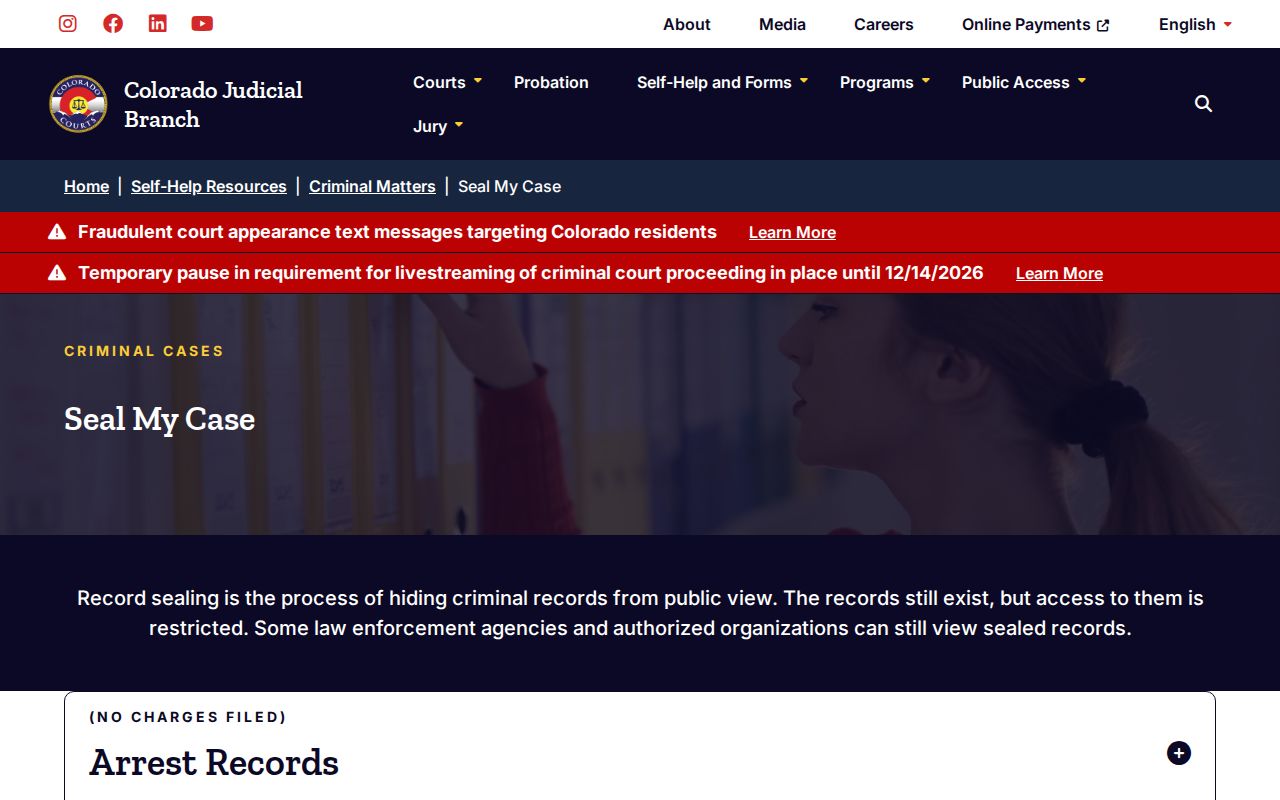
That split makes it easier to match a form to the record and its outcome. A court order still has to reach the agencies or publishers holding a copy. For an arrest with no charges, the current JDF 416 instructions list common grounds. Those grounds include no charges filed, completed diversion, an expired limitation period, or no active investigation. The petition and order name each agency that holds records. Required parties must be served. Once granted, agencies generally seal records within 30 days after receiving the order. In the end, the facts and the active court forms control eligibility.
Colorado Conviction Sealing Waits
Conviction sealing has its own tests. The current JDF 611 guide requires restitution to be paid. Some convictions simply are not eligible. A seal does not vacate a conviction. Government agencies may still use a sealed record for a lawful duty. A later conviction can trigger unsealing.
Wait periods vary by offense. The guide lists one year for petty and petty drug offenses. Class 2 or 3 misdemeanors, drug misdemeanors, and some level 4 drug felonies wait two years. Class 1 misdemeanors, class 4 to 6 felonies, level 3 drug felonies, and most level 4 drug felonies wait three years. The clock starts at the end of proceedings or release from supervision, whichever comes later. Check the current JDF 611 and related forms.
Note: These wait periods summarize a court guide; eligibility depends on the offense, later history, and current forms.
Colorado Arrest Record Corrections
A name, date, or case outcome may be wrong. Start with the agency or court that holds the record. Send the exact record link or case number plus documents showing the error. A court may dismiss a charge or grant a seal. Ask the custodian how it applies that event to its copy. A correction fixes the official file. It does not change a separate publisher copy on its own.
Colorado’s arrest-photo law creates no general private takedown process. The statewide mugshot landscape lists official sources first, then secondary publishers. Private sites may offer free updates for specific outcomes. Their policies are not Colorado law. They are not jail custodians and cannot confirm current custody.
| Route | What the policy says |
|---|---|
| Agency or court correction | Use the office that created the record; attach the court outcome or source document that proves the error. |
| RecentlyBooked | Its free policy covers dismissed, sealed or expunged, wrong-person, outdated, juvenile, and duplicate listings; it asks for the listing URL and supporting details. |
| Mugshots.com | Its free maintenance policy lists sealing, expungement, no-information outcomes, record restriction, identity theft, or death; it requests documentation and a site identifier. |
| BustedNewspaper | Its form describes requests for an existing post with documents for a dismissal, a prosecutor’s decision to stop a case, a not-guilty result, or a seal; no Colorado state page was verified. |
| Search results and archives | A private copy or cached result may remain after a source page changes; removal is not assured. |
RecentlyBooked and Colorado Arrest Listings
RecentlyBooked’s free removal policy covers dismissed, sealed, expunged, wrong-person, outdated, juvenile, and duplicate listings. It asks for the URL, identifying details, a reason, and supporting papers. Its Colorado section showed selected counties and claimed frequent updates within a 30-day window. Those claims do not prove complete coverage. They do not prove current custody. The free policy page states that the request route has no fee. It lists what to send.
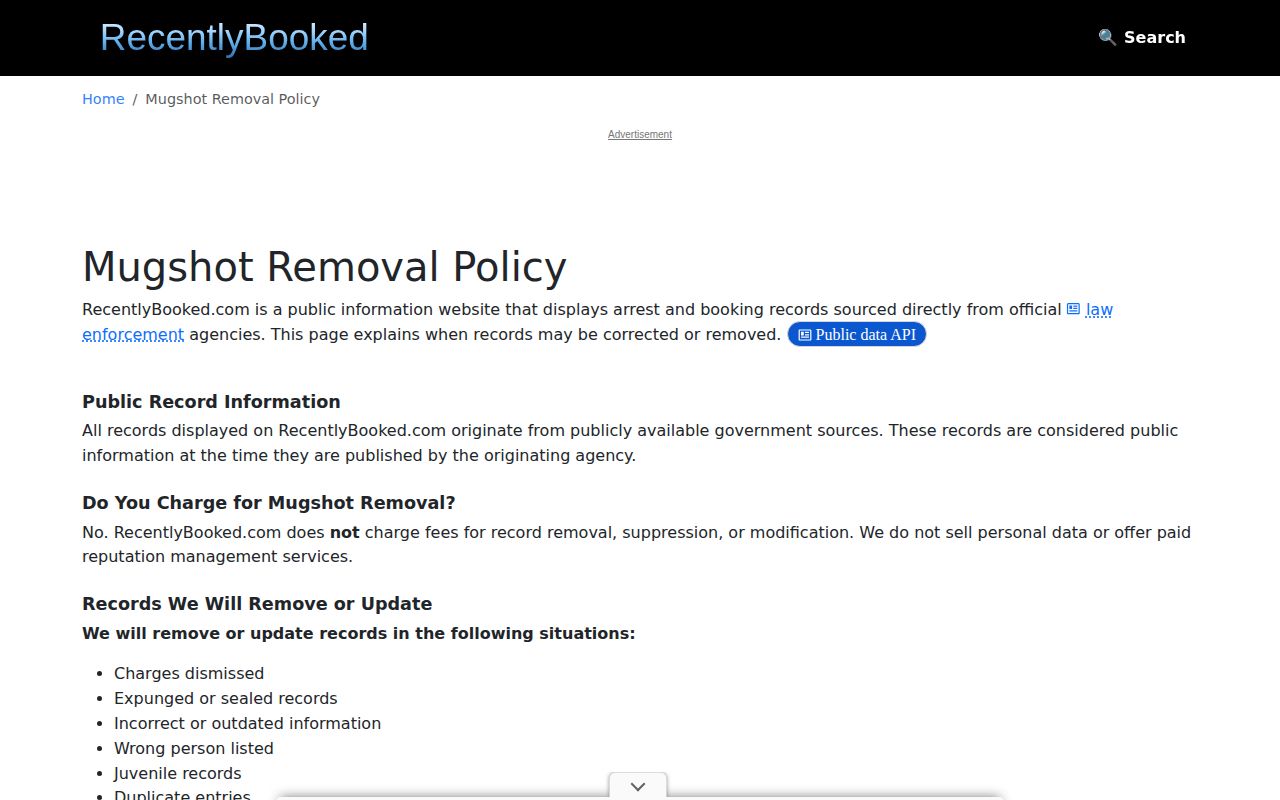
Relief hinges on what a policy allows. Accurate current agency arrest records stay in place regardless.
Mugshots.com Colorado Record Policy
Mugshots.com’s record-maintenance policy treats sealing, expungement, no-information outcomes, record restrictions, identity theft, or death as grounds for an update. It asks for court papers and a site identifier. Its review period runs up to ten business days. That term belongs to the publisher, not Colorado law. The free maintenance policy shows its terms and requested proof.
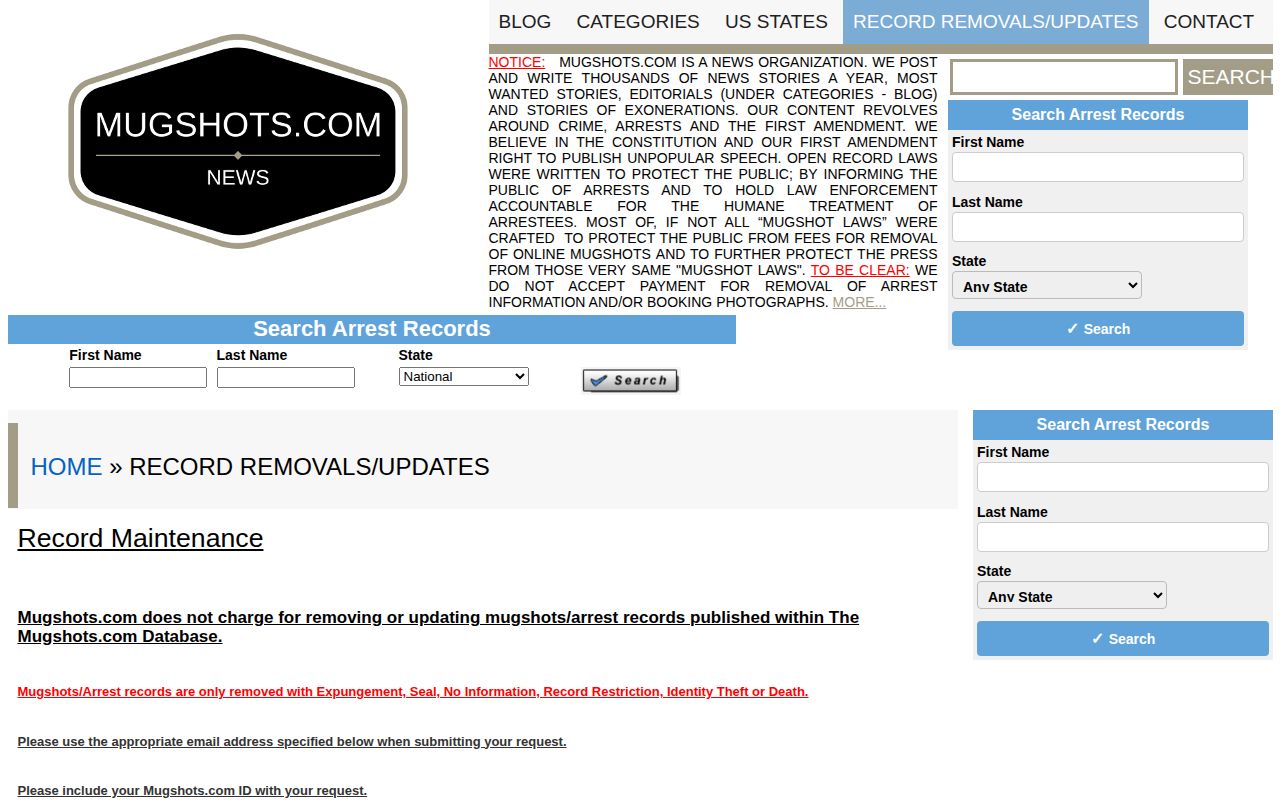
The Colorado index looks uneven and historical rather than a current statewide roster. A stated review time binds no agency, court, search engine, or other publisher.
Note: A publisher’s stated review period is its own policy, not a deadline for a government records office.
BustedNewspaper Colorado Arrest Records
The BustedNewspaper form targets an existing post. It asks for the URL and identifying details. It also wants proof of an outcome, such as dismissal, a decision to stop prosecution, a not-guilty result, or a seal. Reviews take roughly five to ten days under its policy. The free listing-removal form serves a specific post that meets its stated rules.
BustedNewspaper shows no Colorado state section. The publisher's form, in other words, offers no sign of a live Colorado listing. Other secondary arrest sites follow the same pattern. No free removal timetable appears either. Filing a correction never guarantees that accurate reporting or a lawful record will come down. Payment demands are not court orders.
Colorado Arrest News Corrections
News stories are selective. They are not booking systems. A reporter may add context or a court update. Yet the story will never list every arrest. Even a photo in an article can be old. It may not be a current booking photo. When you ask for a correction, include the article URL and the exact error. Attach source documents too. A court result can support an update without forcing the outlet to delete the piece.
The Colorado Sun takes free factual corrections through its editorial standards process. Takedowns, though, are generally denied unless the story is fundamentally flawed. Point to a specific factual error and back it with reliable support. Even then, an outlet's correction procedure never promises the story disappears.
Colorado Arrest Record Retention
Public visibility and retention are two different things. The Colorado State Archives writes retention schedules for state and local agencies. A schedule follows the official copy across paper, digital image, audio, or video. It spells out what may be destroyed and what must stay. A pending case, claim, action, or audit blocks destruction.
No statewide booking-photo retention period exists. A photo might sit in a jail file, case file, evidence file, or request file. Each agency's schedule differs. A roster can drop a person after release. The formal booking record stays with the custodian. Records can also be destroyed once a schedule allows.
The Archives' retention program lays out the statewide framework. Its state-agency guidance covers formats and legal holds. Its body-camera schedule is not a booking-photo schedule. Old corrections photos are not a modern county-arrest archive either.
Note: A roster's visible date range reflects the website's display window. It is not the agency's full retention period.