
How Colorado Arrests First Appear
No single statewide roster collects recent arrests in Colorado. Every arrest starts with the agency that made it. A booking record exists only once a jail takes the person in. From there, each county picks its own format. Some publish a current-inmate list, others a date-filtered booking report, a short-window feed, a PDF, or nothing searchable at all. A person can also be cited and released, moved to another county, booked elsewhere, or filed under a name spelled differently.
That variety explains many dead ends. The source may simply not cover the right county. The entry may not be posted yet. Or the person has already left the jail. A roster can even show an older booking when someone remains in custody. Check the page title and its "as of" time before trusting a row as recent.
Keep the record types apart. A booking report captures an intake event. A jail roster reports current custody. A court docket tracks a case. None of the three can substitute for the others.
Colorado Booking Feeds Use Different Clocks
Colorado counties do not share one upload schedule. They do not even agree on what "today" means. Some sites let you pick a booking date. Others post a morning PDF stamped with an "as of" time. Some count only the prior day's bookings. One county app refreshes its daily-arrest view hourly. A separate current-inmate list answers who is still in custody. A 72-hour page is a near-live window, not a true 24-hour feed.
Several clocks run between the arrest and the post. Jail intake, data entry, report generation, and publication each take their own time. A fresh arrest can miss a batch report already generated. A release can pull someone off the current roster. The booking record stays with the agency. The Colorado 24 Hour Arrests page compares county patterns. It also shows how to reroute a search when no same-day view exists. The Arrest Log window sits in the main navigation.
| Control or view | What it covers | How to read it |
|---|---|---|
| Date selector or date range | A chosen calendar day or booking-from/booking-to period | It is not always a rolling 24-hour search. |
| Booking-from and booking-to fields | An Eagle County date search can cover a selected interval | Enter the dates the official form asks for. |
| Morning report or PDF | A snapshot made at the printed generation time | Use the “as of” label; newer intake may be absent. |
| Booking summary | A report-defined period that can cover the prior 24 hours | Read the report date and its stated window. |
| Daily Arrests / Current Inmates / Daily Releases | Separate Weld views for bookings, present custody, and releases | Select the view that matches the question. |
| 72-hour report | A wider near-live span | It can include arrests older than one day. |
Note: A report's visible dates show when it was published, not how long the agency must keep the underlying record.
Finding Colorado Arrests by County
Begin with the county where the stop, arrest, or intake likely happened. A Colorado State Patrol stop in one county often leads to booking in that county's detention facility. But a transfer or another agency's hold can move the person elsewhere. City police records may stay with the city. Meanwhile, the county jail keeps the booking record. The Colorado County Directory links to each locality site. The official sheriff or detention page sits one click away.
Denver and Broomfield are consolidated city-and-county governments. Their locality pages appear under folder names rather than separate county rows. When the arrest location is unclear, check the court location and the arresting-agency field. For someone possibly in custody, a live roster beats a historical report. The county's VINE route works too. A release, transfer, or booking delay can easily explain why two official pages disagree.
Follow a simple search order. One stale or narrow source should not end the hunt too soon:
- Choose the county or city tied to the arrest, then open that locality’s official sheriff or detention source.
- Pick a current-custody view for a person who may still be jailed, or a booking-date view for a recent intake.
- Use the name, booking number, or date controls that the county page actually provides. Colorado has no shared statewide roster form.
- If the public page has no match, ask the records unit for the booking entry. Check the court later for the filed charge and disposition.
Note: A Colorado State Patrol arrest may be recorded by CSP, while the receiving county jail holds the booking entry and current-custody status.
Where Official Colorado Arrest Records Appear
Different official sources answer different questions. Sheriffs and detention agencies publish whatever roster or booking report they choose to release. Colorado State Patrol posts selected incident and enforcement news, not a full arrest feed. Courts handle case events and outcomes. Corrections and federal locators apply only after custody moves into those systems. The table keeps these records separate. That way a news item or a custody row is never mistaken for a complete arrest history.
| Source | Record purpose | Limit |
|---|---|---|
| County sheriff or jail roster | Current custody or county booking events | Coverage, photos, fields, and update time vary by county. |
| Colorado State Patrol releases | Selected patrol arrests, operations, crashes, and follow-up news | Not a daily arrest roster or dispatch log. |
| Colorado Judicial Branch records guide and docket route | Case location, filings, hearings, and later disposition | Not a jail roster or complete free document archive. |
| CDOC Offender Search | State-prison custody and corrections profile | Not a fresh county booking source. |
| Federal Bureau of Prisons locator | Federal inmates in BOP custody | Text locator, not a public mugshot source. |
| RecentlyBooked Colorado | Third-party county-page index with a vendor-stated coverage window | Research observed 15 county pages; coverage is not complete or official. |
| Mugshots.com Colorado | Historical and county-linked third-party pages | Coverage is uneven and may lag a changed government record. |
| Arrests.org Colorado | Third-party search with selected county material | Not a full statewide roster or current custody source. |
| Denver7 crime coverage | Selected news and public-safety reporting | Editorial coverage, not a complete booking list. |
Newsroom crime coverage adds context when an incident matters publicly. Editors pick which stories run. They may update a piece after a court hearing. Plenty of bookings never get covered at all. So silence from a paper proves nothing either way. Still, a news story is not the official booking sheet. Outlets like 9NEWS, CBS Colorado, CPR News, and The Colorado Sun run selected reporting. That reporting is not a jail feed. Busted Newspaper and Mugshots.zone list no Colorado state section. So neither gets a link here.
The Denver7 crime archive shows that editorial form plainly. Treat it as context, not a roster.
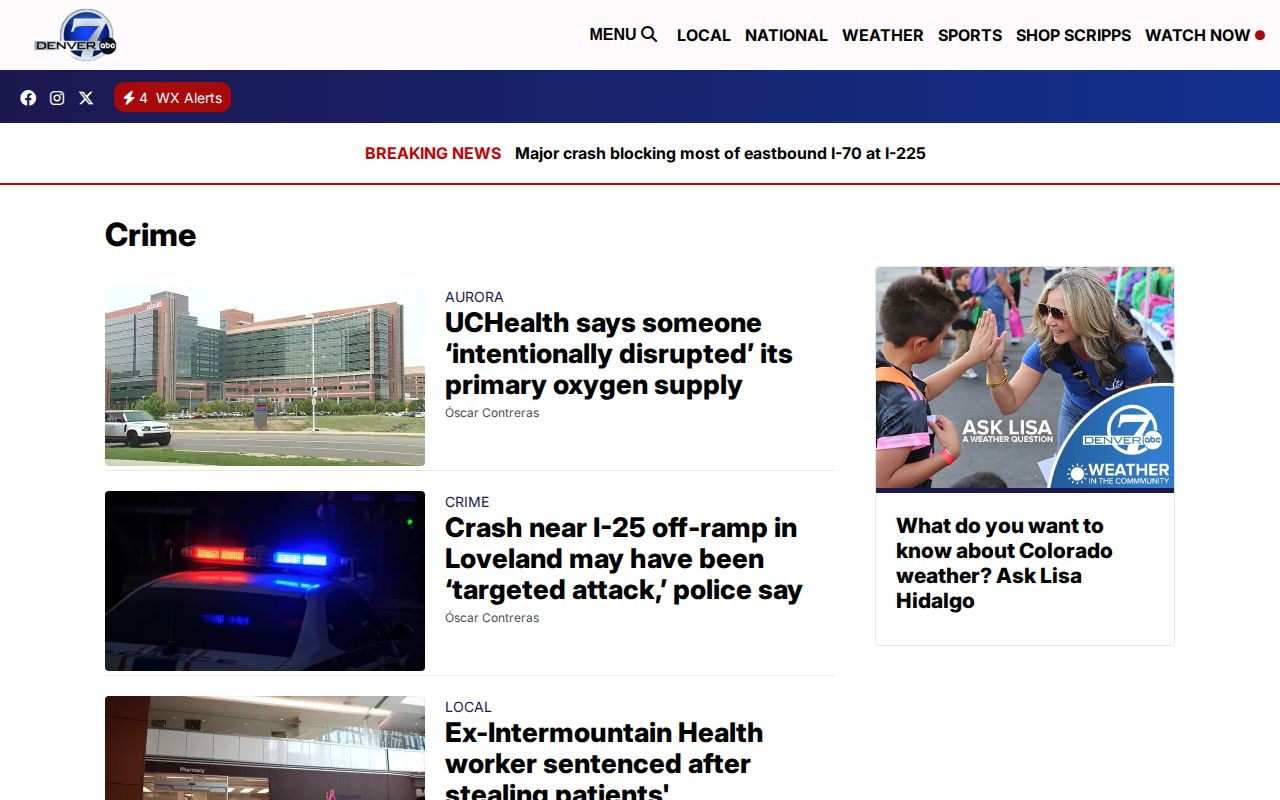
Use news coverage for context, then confirm any arrest through the official agency and court record.
Colorado Booking Records, Field by Field
The Colorado Criminal Justice Records Act goes by CCJRA. It spells out what counts as arrest and criminal-record information. That definition covers the person's identity, the agency involved, and the date and place. The charges and the outcome count too. A county booking page may show only part of that record. "Current custody" is its own field, not a stand-in for the booking event itself. A photograph qualifies as basic identification under the Act. Even so, that label does not oblige every county to post or release an image.
State prison works differently. A Colorado Department of Corrections profile is a separate record. It may carry a DOC number, descriptors, facility or status, sentence details, parole dates, and an offender photo. It does not prove a fresh county arrest. Federal BOP and ICE records answer their own custody questions.
| Record field or layer | What it can tell you |
|---|---|
| Identity and related identifiers | Who the official action concerns; compare identifiers carefully when names are common. |
| Agency, date, and place | Which agency acted and where and when the arrest event was recorded. |
| Nature of charges | The charge recorded at that stage; it may change as a case proceeds. |
| Disposition | A later case result when included in the record; the court remains the controlling source. |
| Booking photograph | A basic-identification record whose online display and release depend on the custodian and law. |
| Custody status | Whether a participating jail reports the person in custody now, not every past arrest. |
Intake labels can be incomplete or later corrected, and a court may dismiss or amend a charge. Match the agency, date, county, and case number before drawing any conclusion from a booking entry.
Note: The name, date, agency, and case number together help separate records when two people share a similar name.
Colorado Arrest Photo Access Varies
Colorado has no single statewide booking-photo feed. County policy and roster design decide what a visitor sees. Mesa sample booking summaries included an image area. A Teller booking detail can show a photo. Boulder, Larimer, Gunnison, and Weld keep text-oriented public views. Photo questions there get routed to Records or left without a firm promise. Some counties list current inmates but offer no image field at all.
A CDOC offender photograph belongs to a state-corrections profile, not a county booking page. Colorado's C.R.S. § 24-72-305.5 targets one specific pay-to-remove publication model. It does not ban every publication. Nor does it force every old copy offline. The detailed rules appear in the statewide arrest-record law treatment.
Note: A county photo field reflects a publication choice, not a statewide rule.
Colorado Third-Party Arrest Pages
Third-party pages give a second discovery path. Their county coverage is uneven, though. Entries can lag behind a changed government record. RecentlyBooked's Colorado section lists 15 county pages and promotes a 30-day coverage concept. Those are vendor claims. They are not proof of full state coverage or current jail custody. Arrests.org also shows selected county material and disclaims completeness itself.
The RecentlyBooked Colorado index shows how that vendor groups its county links. Think of it as a secondary index, not a government roster.
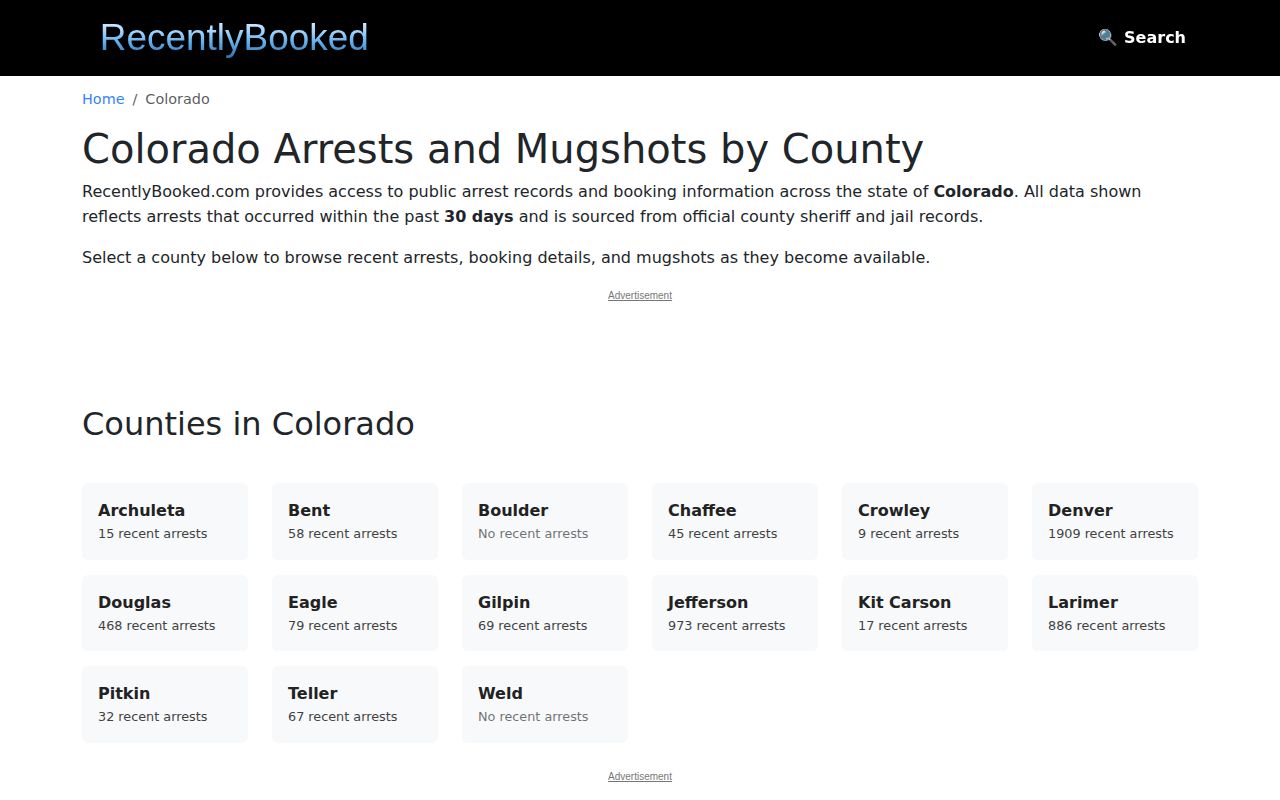
Confirm the booking, custody status, and any court outcome on the county agency's own page.
Colorado Corrections Photo Archives
Mugshots.com's Colorado section skews historical and uneven by county. A page may preserve an old copy after the official source changes, so it is no substitute for a current custody check. Busted Newspaper and Mugshots.zone list no Colorado state section either.
The Mugshots.com Colorado section illustrates a secondary archive page, not an official record feed.
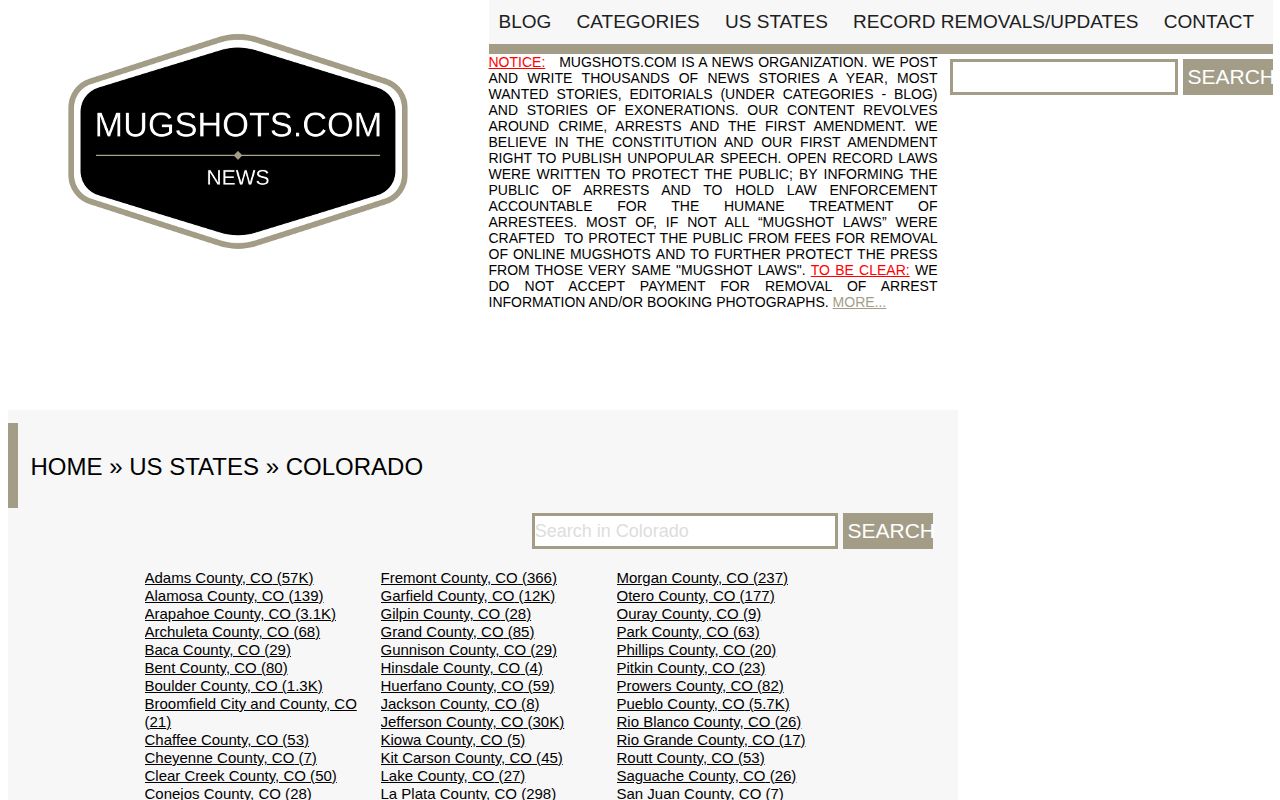
Need a correction or update? Start with the source agency or court. Private copies may need a separate, policy-based request.
Requesting a Colorado Booking Record or Photo
A records request is the fallback. A county feed may be missing, stale, or short on detail. Under the CCJRA, an official action is generally open for inspection. Other criminal-justice material can be released at the custodian's discretion or withheld under law. A photo request is not automatic. Investigigative status, privacy and safety interests, and juvenile rules all shape the answer. Court orders and the record category matter too.
Keep the request narrow. The county sheriff or detention agency usually holds the booking record. CSP holds records it created during a patrol event. Ask for the specific item rather than a bulk set of photographs. A clear request helps the custodian locate the record. It can also explain a denial or route you to the right office.
- Identify the county and arresting agency. Use the Colorado County Directory if the booking location is not clear.
- Give the person’s name, an approximate arrest or booking date, the place or agency, and a booking or case number if known.
- Name each record sought, such as the booking entry, an incident report, or a specific booking photograph. Ask whether the item is open under the CCJRA and whether redactions or fees apply.
- For a Colorado State Patrol report, use the CSP 402C public-record request form and follow its submission instructions. Do not assume a press release is the underlying report.
What does a Colorado booking record cost? Under the CCJRA, an agency may charge reasonable actual costs for searching, retrieval, redaction, and copies. Nonstandard formats get special treatment. Fees vary from county to county. CSP publishes a separate fee schedule for its own requests. The Colorado Judicial Branch runs its own case-document request process. It aims to respond within three business days unless something unusual comes up. That clock belongs to the courts. It does not bind a jail booking request.
Note: A record can vanish from an online display long before the agency's retention period ends, so ask the custodian about the record series and its schedule.
Does a "recent" label mean the same window in every county? No. A date picker, a daily report, a current-inmate list, and a 72-hour view each answer a different question. Check the control and the printed time before comparing results across counties.
What Colorado Law Says About Booking Photos
Colorado law splits public records into two streams. The CCJRA governs criminal-justice records, while the Colorado Open Records Act covers public records more broadly. The statute separates official actions from other materials. Arrests, filed charges, and dispositions count as official actions, though access still has limits. Material outside that category sits at the custodian's discretion. An agency can also deny a request when another law or court rule applies, or when releasing investigative, intelligence, or security records would work against the public interest.
One statute targets booking photos directly. C.R.S. § 24-72-305.5(2) makes it unlawful to knowingly obtain a booking photograph while knowing it will be published in a way that demands payment, or some other pecuniary exchange, for removal. The rule is narrow. It is not a blanket ban on publishing booking photos. It creates no universal photo-release mandate. It also grants no automatic deletion right once a case ends. The 2014 session law added the core safeguard, and the current statutory text controls. Sealing and juvenile expungement run through their own separate court processes, not through this provision.
Colorado Warrants and Statewide Wanted Lists
A wanted-person list is not a statewide arrest feed. A fugitive notice is not a complete warrant search either. Colorado's official statewide routes come from three authorities. The Colorado Bureau of Investigation's dated January 2026 Top 20 Most Wanted list concerns wanted sex offenders. Wait, use the correct address. The CBI posts a dated January 2026 Top 20 Most Wanted list for wanted sex offenders, with a CBI tip line and email attached. That list carries a date and can change. It is not a daily booking report.
The CDOC fugitive page covers people who have absconded or escaped from state corrections or supervision. CDOC tells the public plainly: do not contact a fugitive directly. Tips go to 1-866-873-6305. The U.S. Marshals Service keeps a Colorado district page, though it lists no profiled fugitives; the Marshals' national profiled-fugitives list is the wider federal route. None of these categories equals a county warrant or a fresh jail booking.
Checking a possible county warrant? Start with the court or the sheriff serving that county, or seek legal counsel for case-specific help. No single statewide public warrant page exists in Colorado. Verify the issuing court and current status through an official office before acting. If a listed person may be nearby, do not approach, follow, message, or try to detain them. Call 911 for immediate danger. Use the agency's listed tip channel for anything else. The CDOC page models the right habit: send the tip to the agency, never to the person.
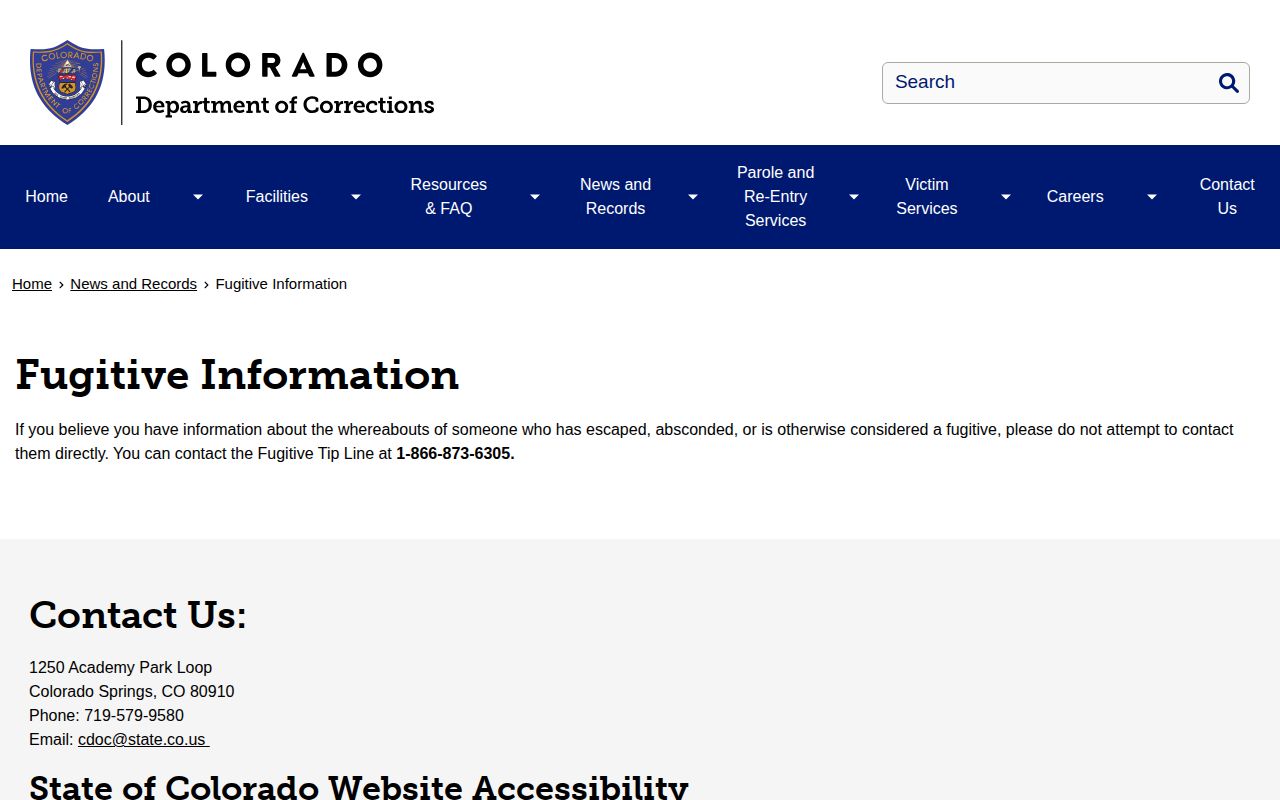
This is a corrections fugitive notice, not a county jail roster or an invitation to investigate anyone.
Safety: Never confront a wanted person. Use the listed law-enforcement channel, or call 911 for an immediate threat.
Colorado Arrest Cases in Court Dockets
The Colorado Judicial Branch docket search filters by location, district, county, courthouse, case type, date, case number, party, and attorney. It helps you locate a case. It is not a complete statewide criminal-history tool. The court's public-records guide notes that not every court document is free online. A clerk or a record request may be needed for the file itself.
A booking charge can shift as a case moves. It may be amended, reduced, dismissed, or replaced. A disposition is the later case result. A jail roster reports custody, and a booking sheet records intake. Search the right court level and spelling, especially with municipal cases or consolidated city-county courts. A missing docket can mean several things. The case was never filed, the wrong location was picked, or the record is restricted. It does not disprove a booking.
The Colorado Judicial Branch public-records access guide is an official access guide, not a jail search. It shows which records a court can provide, and where an arrest feed ends.
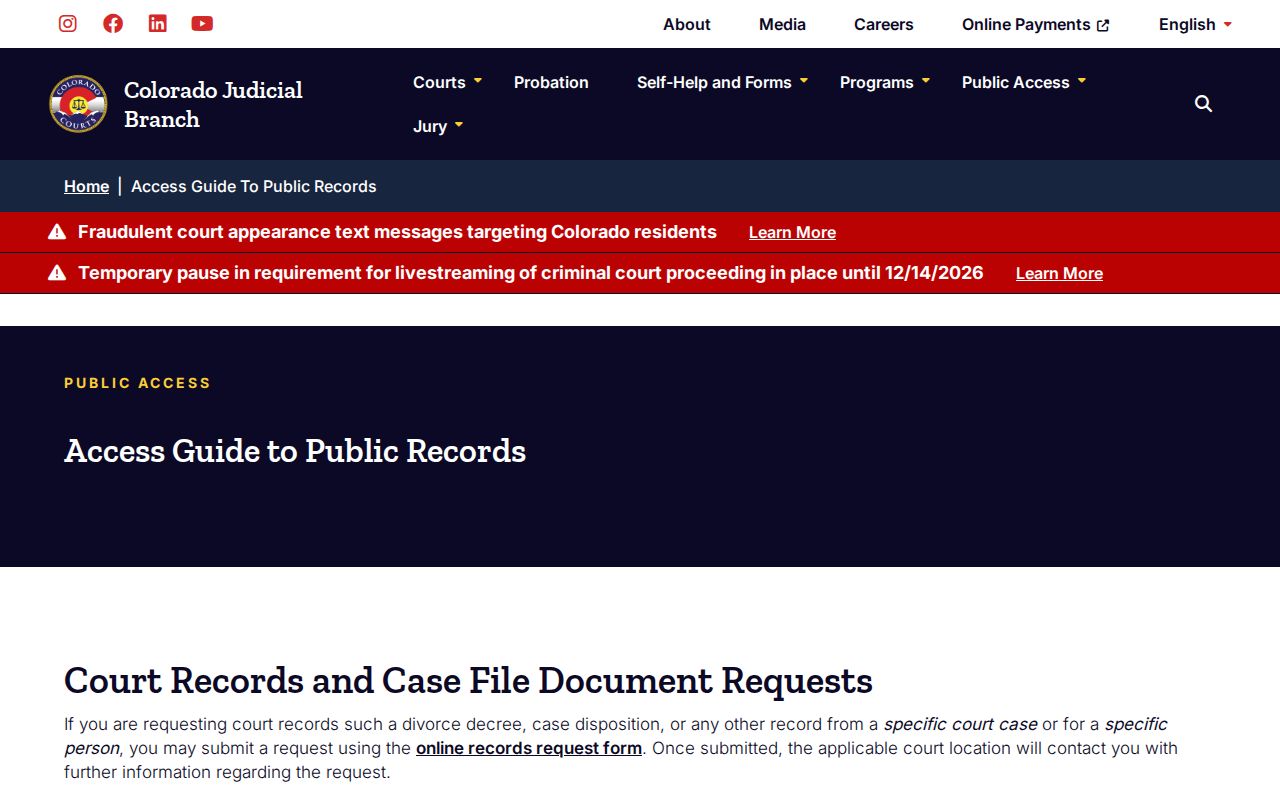
For a fresh custody event, go back to the county jail source. Use the docket later to check filings and disposition.
- Booking
- The jail intake process and record after a person is accepted into custody.
- Disposition
- The court’s later result in a case, such as dismissal or a judgment.
- Sealing
- A court-ordered limit on public access to eligible adult records.
After Booking: Colorado Courts and Custody
One arrest can leave footprints in several record systems. The county jail tracks booking and current custody. Court files hold the charges, hearings, and outcome. A prison sentence moves the record to the CDOC locator. Federal cases work differently. Pretrial custody there runs through the U.S. Marshals Service, and sentenced inmates show up in a federal system of its own.
The BOP locator lists federal inmates held from 1982 forward. It updates daily. It returns text custody data, not booking photos. The CDOC search sits on the state corrections side, not in a county jail roster, though its profile can show a photo when the system supplies one. A VINE no-result only covers its own stage; a later corrections check still matters. Read each source for the custody stage it tracks.
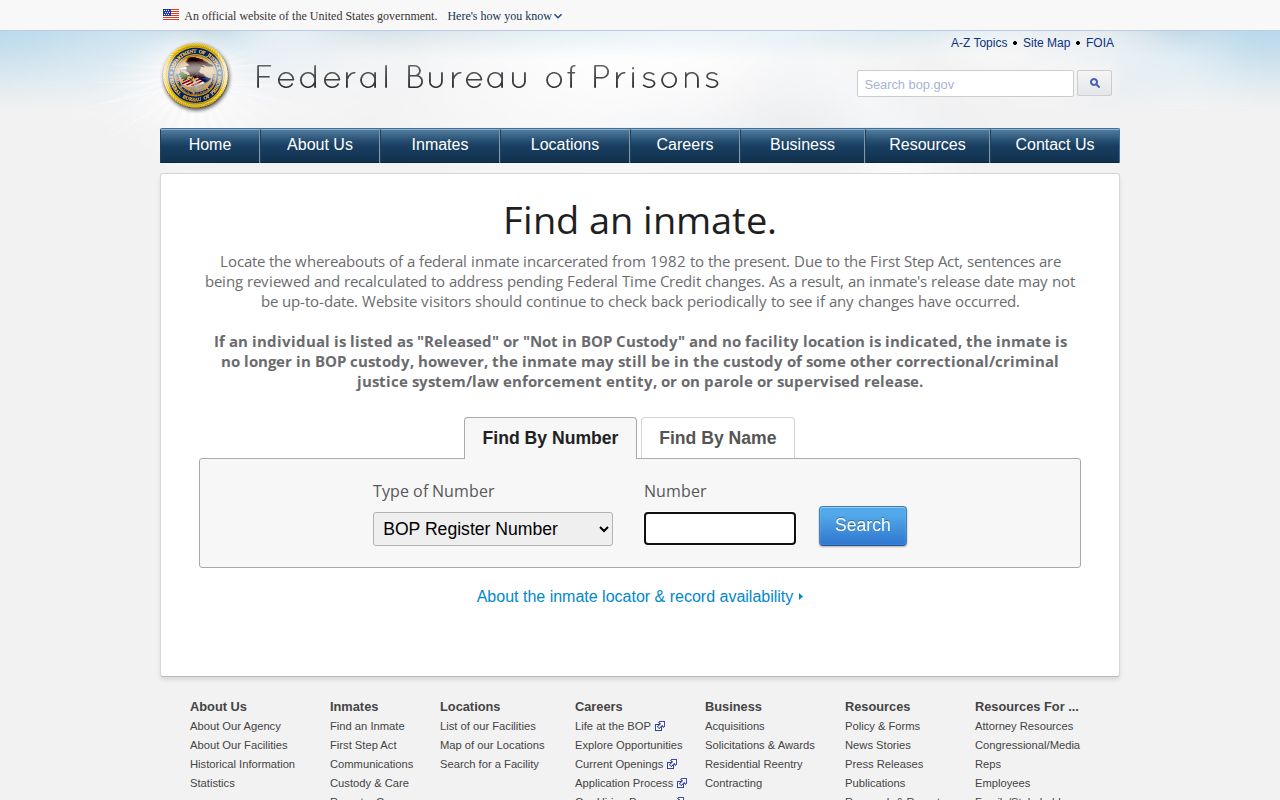
A federal result says nothing about a county arrest. For that question, go to the arresting agency and the county jail.
Courts, not booking desks, settle the case. The court record is the proper source for the later result.
Colorado Arrest Records in Archives
Online roster depth in Colorado is one thing; an agency's retention period is another. The State Archives writes retention and disposition schedules for public agencies. Rules vary by record series and format. A pending case, claim, action, or audit can block destruction. No single statewide booking-photo retention term exists. Ask the originating agency which schedule covers its booking system, report, evidence, or image.
Older material is a different story. The Archives holds State Penitentiary and Reformatory records. These include prisoner registers, parole files, and mugshots for many inmates. Reformatory mugshots run from 1927 to 1992. That collection aids corrections research, but it is not a modern county booking archive. A current arrest question belongs first with the county sheriff or detention custodian. A historical image should be read as an archival corrections record rather than a current mugshot. The corrections collection page describes those holdings. The State Archives schedule page explains how its rules reach paper and digital formats alike. An old public web page, in short, does not set the legal retention term.
A retention schedule names the rule that applies. It does not fix one statewide term for every county booking photograph.
Requesting Colorado Archival Records
Requesting archival records is straightforward. The State Archives takes online forms, email, or mail. Give a name, a time span, or a call number. In-person research needs an appointment. Requests and on-site viewing are free, though copies and some services carry fees. Timing varies with identification, access status, digitization, and staff workload. No universal turnaround is promised. The Archives request page sets out the formal route for older corrections records.
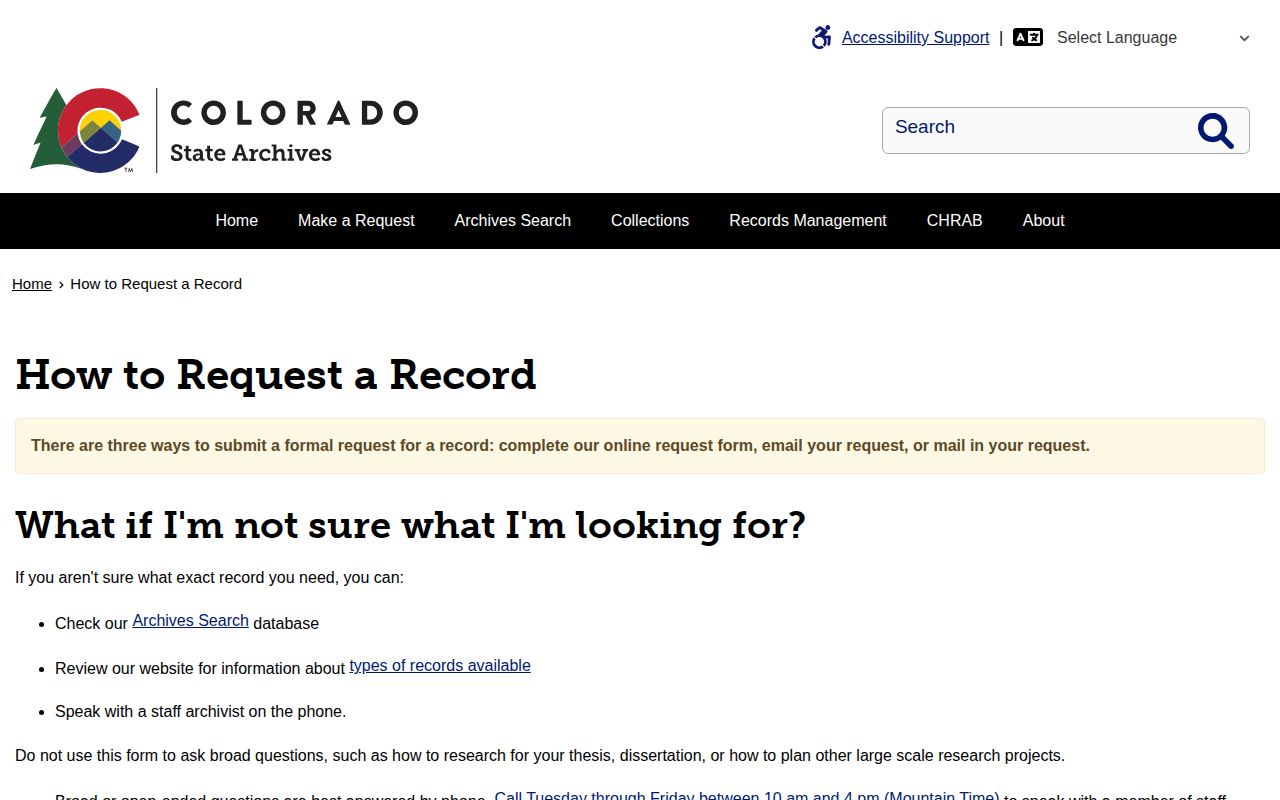
For a fresh county booking, ask the county custodian instead. The Archives does not replace a live roster.